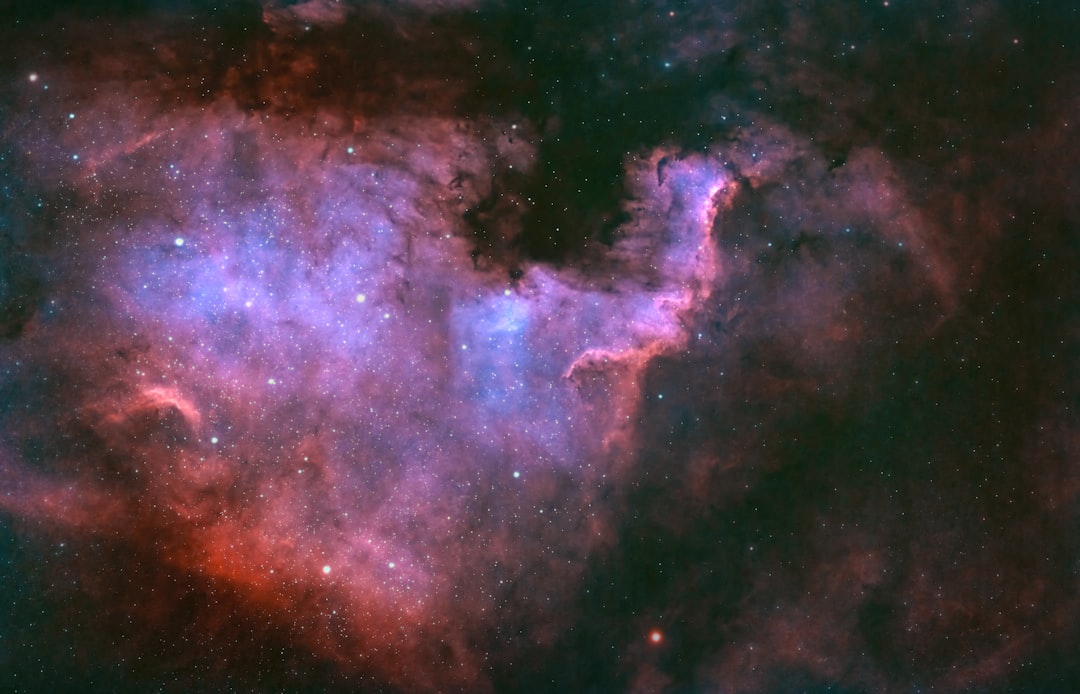
NASA has released the first detailed map from its SPHEREx mission showing where water ice and complex carbon-bearing molecules reside across Cygnus X, one of the Milky Way’s most active star-forming regions. The image, described by the agency as revealing vast “interstellar glaciers,” highlights water ice in bright blue and polycyclic aromatic hydrocarbons (PAHs) in orange.
The result, reported by NASA’s science division and the agency’s main site, offers an early look at how SPHEREx — short for Spectro-Photometer for the History of the Universe, Epoch of Reionization, and Ices Explorer — can track the raw ingredients that may eventually form stars and planets.
What SPHEREx Saw in Cygnus X
According to NASA’s science communication on the mission, the new observation captures the “chemical signatures” of both water ice and PAHs spread throughout Cygnus X. Chemical signatures here mean specific patterns in infrared light that correspond to particular molecules.
In the released visualization:
- Water ice appears in bright blue, tracing cold regions where frozen material coats dust grains.
- PAHs, a family of complex carbon-based molecules, appear in orange.
Cygnus X is already known to astronomers as one of the Milky Way’s most turbulent star-forming complexes. By overlaying the locations of ice and PAHs on this region, SPHEREx provides a map of where key materials are concentrated inside a galactic “factory” of new stars.
NASA’s description emphasizes that this is not just a pretty picture. It is a data product built from SPHEREx’s infrared measurements, tuned to detect the wavelengths where water ice and PAHs leave distinctive imprints.
How SPHEREx Works, in Plain Terms
SPHEREx is a space-based spectro-photometer. In practical terms, that means it does two things at once:
- Photometry: It measures how bright objects are in different colors of infrared light.
- Spectroscopy: It breaks that light into many narrow wavelength bands, looking for patterns that match known molecules.
NASA’s materials on the mission explain that SPHEREx is designed to survey the entire sky in infrared light, repeatedly, rather than focusing on a single small patch. This wide coverage is key to its broader science goals, which include studying:
- The history of the universe, by mapping how galaxies are distributed in three dimensions.
- The epoch of reionization, an early period in cosmic history when the first stars and galaxies ionized hydrogen gas.
- Ices in space, such as water, carbon dioxide, and other frozen molecules on dust grains and in clouds.
The Cygnus X map falls squarely in this third category. By using many narrow infrared bands, SPHEREx can distinguish between light absorbed or emitted by water ice and by PAHs. The result is a chemical map, not just a brightness map.
Why Mapping Water Ice in Cygnus X Matters
NASA’s description of the Cygnus X result repeatedly highlights water ice and PAHs because they are central to how interstellar material evolves.
Water ice in space typically forms when individual water molecules freeze onto tiny dust grains in cold, dense regions of gas. These icy grains can clump together, forming larger particles that eventually participate in building planets. PAHs, meanwhile, are complex carbon-based molecules that sit at an intermediate step between simple gas molecules and more elaborate organic material.
By mapping where these substances are concentrated in Cygnus X, SPHEREx helps astronomers answer practical questions:
- Where is the cold, dense material that can feed future star and planet formation? The bright-blue ice regions trace those reservoirs.
- How are carbon-rich molecules distributed relative to water ice? The orange PAH structures show where complex carbon chemistry is active.
NASA’s framing of the map as revealing “interstellar glaciers” underlines the scale involved: these are not small patches of frost, but vast regions of frozen material spanning light-years.
What This Tells Us About Star-Forming Environments
Cygnus X is described by NASA as “one of the most active and turbulent regions of star birth” in the Milky Way. Turbulence here refers to chaotic motions of gas and dust driven by processes such as stellar winds, radiation from massive stars, and possibly supernova remnants.
Within that environment, the SPHEREx map shows where relatively fragile ices can survive and where they coexist with PAHs. This combination offers clues about the balance between:
- Destructive processes, like intense radiation that can break apart molecules.
- Protective environments, such as dense clouds that shield ices and complex molecules from harsh light.
Although NASA’s current public materials focus on the visual and chemical mapping rather than detailed numerical analysis, the implication is clear: by locating stable reservoirs of ice in such a violent region, SPHEREx helps scientists pinpoint where conditions are suitable for building up the solid material that may one day form planets.
How This Fits Into SPHEREx’s Broader Science Goals
The mission’s full name — Spectro-Photometer for the History of the Universe, Epoch of Reionization, and Ices Explorer — signals that SPHEREx is designed to tackle several big questions at once. NASA’s descriptions of the mission emphasize three intertwined themes:
- History of the universe: By mapping galaxies across the sky and measuring their redshifts (how much their light is stretched by cosmic expansion), SPHEREx can trace how structure has grown over time.
- Epoch of reionization: By looking for signatures of early galaxies and their effects on surrounding gas, SPHEREx contributes to understanding how the universe transitioned from opaque to transparent.
- Ices explorer: By surveying ices like water and carbon-bearing molecules across many environments, from nearby clouds to more distant regions, SPHEREx builds a comparative picture of where and how these materials accumulate.
The Cygnus X map sits in this third pillar but also supports the first two indirectly. Understanding how matter is organized and transformed in a nearby star-forming region provides a local reference point for interpreting more distant, less resolved regions in other parts of the galaxy and beyond.
NASA’s emphasis on reionization, photometer, universe, and explorer in its descriptions underscores that the same instrument design — broad, repeated infrared sky coverage with spectral sensitivity — underlies all these goals. The Cygnus X result is an early demonstration of how that design pays off for ice mapping.
Who Benefits From This New View of Cygnus X
The immediate stakeholders in this result are scientists working on:
- Star and planet formation: They gain a map of where water ice, a key solid component, is concentrated in a benchmark star-forming region.
- Interstellar chemistry: Researchers studying how simple molecules grow into more complex ones can compare PAH-rich regions to ice-rich zones.
- Infrared instrumentation and survey science: The Cygnus X map serves as a proof-of-concept that a wide-field spectro-photometer can deliver detailed chemical maps over large areas of sky.
NASA’s own communications present this as an early product in a broader survey program. For mission planners and data analysts, the map tests how well SPHEREx’s observing strategy, calibration, and data processing pipeline can isolate specific molecular signatures across a complex region.
For the wider research community, the value lies in having a consistent, all-sky dataset. The Cygnus X result hints at what will be possible when similar maps are available for many star-forming regions, allowing direct comparisons of where water ice and PAHs are abundant or scarce.
What Comes Next for SPHEREx and Ice Mapping
NASA’s descriptions of SPHEREx outline a survey mission that will repeatedly scan the entire sky in infrared light. Within that framework, the Cygnus X map is one example of the kind of product the mission is expected to generate over the coming months.
In the near term, several developments are plausible:
- More regional ice maps: As SPHEREx continues its survey, similar chemical maps of other star-forming complexes are likely to emerge. The key indicator to watch is NASA’s release of additional images and analyses highlighting water ice and PAHs in different regions.
- Comparative studies within Cygnus X: With a baseline map in hand, astronomers may focus on substructures inside Cygnus X, comparing areas with strong ice signatures to those dominated by PAHs to infer differences in radiation exposure and density.
- Refined data products: Early maps often lead to improvements in calibration and analysis methods. Future SPHEREx releases may include more detailed breakdowns of ice composition or clearer separation of overlapping signals as the team refines its processing pipeline.
There is uncertainty about the exact pace and sequence of these steps, since NASA’s public materials do not specify a detailed schedule for future map releases. However, given the mission’s stated all-sky survey approach and its emphasis on ices, it is reasonable to expect that the Cygnus X result will be followed by a growing catalog of similar datasets.
For readers, the key point is that this first map is less an endpoint than a preview. It shows that SPHEREx can turn faint infrared signatures into large-scale chemical maps, opening the door to a more systematic inventory of where the galaxy stores its “interstellar glaciers” of water ice and complex carbon molecules.