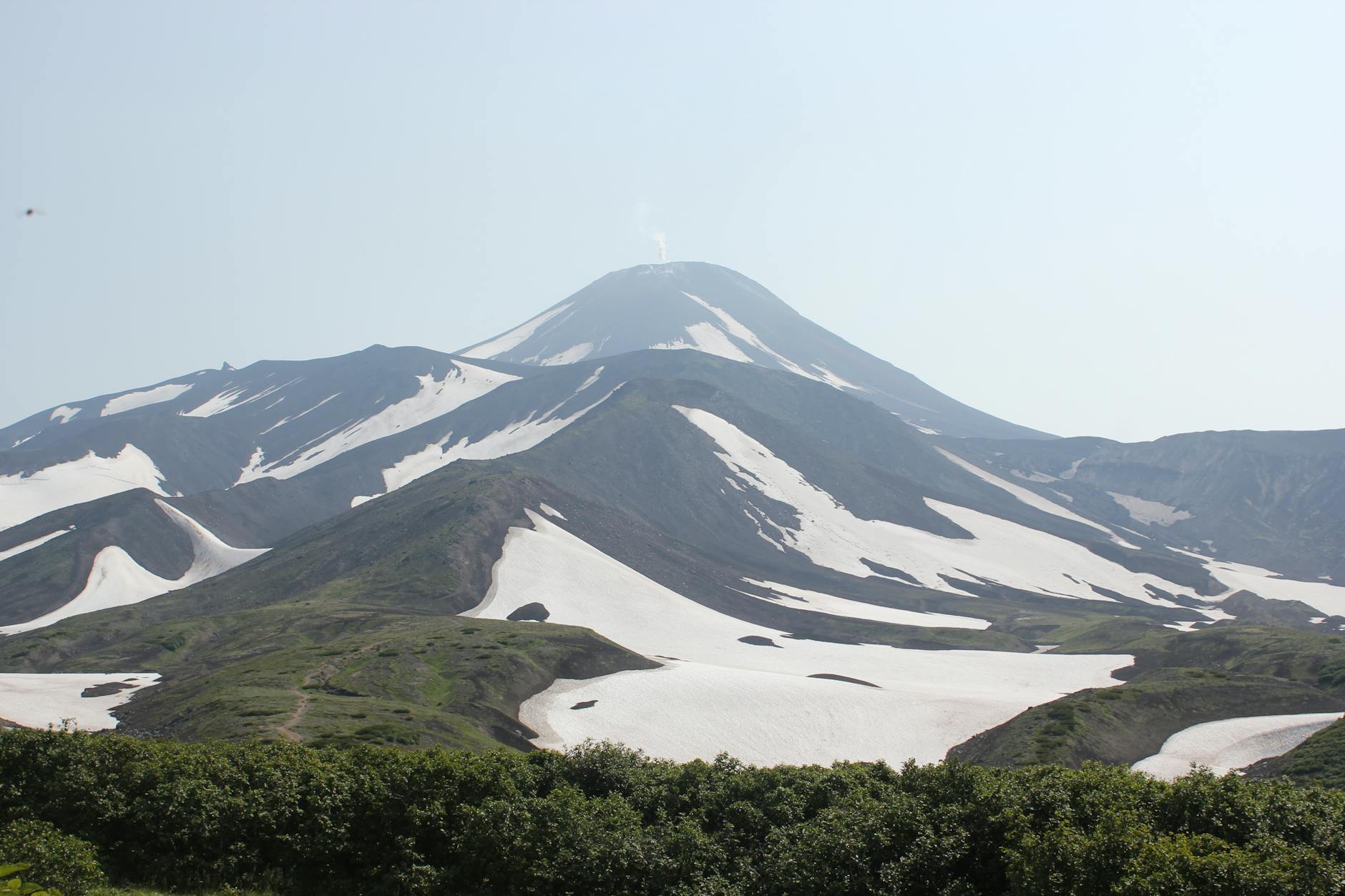
Persistent volcanic activity at Russia’s Shiveluch volcano has generated enough heat to melt surrounding snow, revealing fresh deposits on its flanks, according to satellite observations published by NASA’s science team.
The observations, drawn from Earth-orbiting instruments and summarized by NASA’s Earth science division, indicate that the volcano has remained in near-constant unrest over recent months. The heat from this activity is sufficient to strip away winter snow cover around the summit and upper slopes, exposing darker volcanic material beneath.
What the satellite images show
NASA’s account describes imagery in which snow that typically blankets Shiveluch at this time of year has been partially removed around the active parts of the volcano. In those areas, sensors detect warmer surfaces and darker tones consistent with bare rock and ash rather than reflective snow.
In satellite data, snow usually appears bright because it reflects a large portion of incoming sunlight. When snow melts away, darker ground absorbs more light and appears as a contrasting patch. NASA’s analysis notes that these exposed areas line up with zones of known volcanic activity on Shiveluch, suggesting that the heat source is the volcano itself rather than a regional weather anomaly.
The same imagery shows that the surrounding landscape beyond the immediate volcanic edifice remains snow-covered, reinforcing the conclusion that the melting is localized and linked to ongoing unrest rather than broad seasonal thaw.
A volcano in near-constant activity
NASA’s report characterizes Shiveluch as being in “near-constant” activity during the current observation period. In practice, this means the volcano has not returned to a fully quiet state between episodes, but instead continues to release heat and material in some form.
From orbit, this persistent activity is visible as thermal anomalies—areas that appear significantly warmer than their surroundings in infrared wavelengths. NASA’s scientists interpret the combination of thermal signatures and snow loss as evidence that Shiveluch is continuously emitting enough heat to alter the local snowpack.
The agency’s write-up does not provide a detailed breakdown of each individual eruptive pulse or a full timeline of events. Instead, it emphasizes the overall pattern: ongoing unrest, sustained heat output, and repeated modification of the snow cover around the summit and active vents.
Where Shiveluch is and why satellites are watching
Shiveluch is a large stratovolcano located in Russia. NASA’s science team highlights it as one of the volcanoes regularly monitored from space because its remote position and frequently harsh weather can make continuous ground-based observation difficult.
Satellites can detect signs of volcanic change even when clouds or storms obscure the view in visible light. Infrared sensors, for example, can pick up heat through some cloud layers, and radar instruments can track changes in the volcano’s surface shape. In the case of Shiveluch, NASA’s current reporting focuses on optical and thermal data that clearly distinguish between cold snow and warmer exposed deposits.
NASA’s article on the event underlines how these tools allow scientists to track activity at volcanoes that are far from major population centers but still important to understand, whether for aviation safety, regional planning, or scientific research. The agency does not, however, provide a detailed hazard assessment for this particular episode in the material currently available.
How snowmelt signals volcanic heat
The melting pattern around Shiveluch provides a straightforward physical signal of volcanic heat. Snow and ice require a substantial amount of energy to change from solid to liquid. When a volcano is quiet, winter snow can accumulate and persist, insulating the ground beneath. When the volcano becomes active, rising magma, hot gases, and newly deposited ash can raise ground temperatures enough to melt that snow.
NASA’s description of “melting snow off Shiveluch” points to exactly this process. The exposed surfaces likely include a mix of recent ash, older lava flows, and other volcanic debris. Because these materials are darker than snow, they absorb more sunlight and can further accelerate local melting once they are uncovered.
This kind of snow loss is not, by itself, an indicator of a specific eruption size or style. Instead, it is a visible sign that the volcano is transferring heat to the surface over an extended period. NASA’s reporting stays close to what the satellites can directly observe: warmer ground, reduced snow cover, and the spatial match between those features and the known active parts of the cone.
Evidence and remaining uncertainties
The current public description of events at Shiveluch relies primarily on NASA’s satellite-based analysis. That gives a clear, instrument-backed picture of surface changes and heat, but it does not yet include extensive corroboration from independent monitoring networks in the same level of detail.
NASA notes that independent corroboration of this specific observation cycle remains limited so far and should be monitored as additional reporting becomes available. That caveat does not contradict the satellite evidence; rather, it highlights that much of what is known at this point comes from one primary stream of data.
On key points—localized snowmelt, persistent heat signatures, and the characterization of near-constant activity—the information is grounded in NASA’s own measurements and interpretation. What remains less well documented in the current material is how this particular phase compares quantitatively to past unrest at Shiveluch, or how regional agencies are assessing any associated hazards.
Why this matters
The ongoing snowmelt around Shiveluch is important because it signals sustained volcanic heat strong enough to reshape the local winter landscape. NASA’s satellite observations show that this is not a brief, isolated burst of activity but part of a continuing pattern of unrest.
For now, the clearest takeaways are that Shiveluch remains active, that its heat output is sufficient to melt surrounding snow, and that these changes are being tracked primarily through space-based instruments. Further ground reports or additional satellite analyses will be needed to clarify how this phase of activity evolves and what, if any, broader impacts may follow.