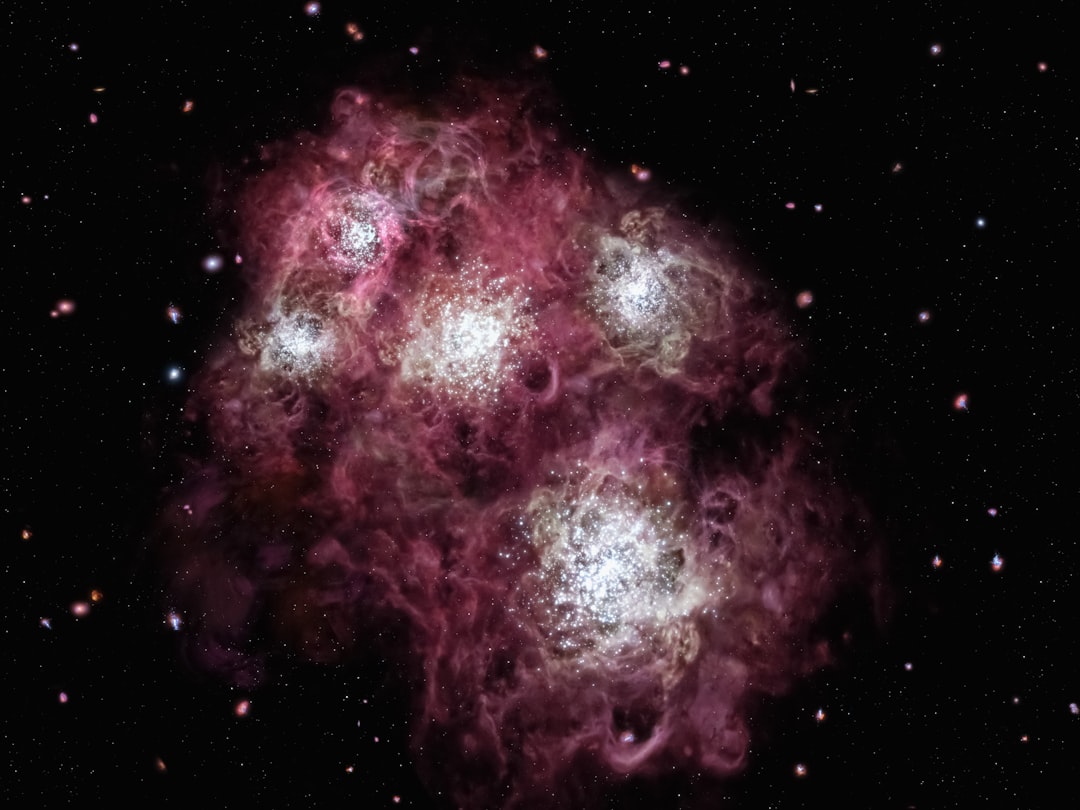
A new image from NASA’s Hubble Space Telescope shows a spiral galaxy sparkling with compact knots of light, each marking a cluster of stars. The agency released the picture as part of its ongoing program to observe nearby galaxies in high detail, highlighting how Hubble continues to deliver sharp views of cosmic structures decades after its launch.
NASA’s science team describes the galaxy as a classic spiral, with curved arms that wind out from a bright central region and are dotted with luminous star clusters. These clusters stand out in the Hubble image as concentrated points along the arms, tracing where stars are packed together more densely than in the surrounding disk.
What the New Hubble Image Shows
According to NASA’s description of the observation, the newly released picture focuses on a single spiral galaxy whose disk is seen in enough detail to pick out individual clusters of stars. In the image, the galaxy’s central bulge appears as a bright, rounded core. From there, several spiral arms extend outward, each arm speckled with compact star clusters that glitter against the darker background of space.
Hubble’s instruments are designed to capture light in visible and near‑infrared wavelengths, roughly the same range the human eye can see plus slightly redder light. In this observation, that capability allows astronomers to distinguish between the smooth glow of older stars in the galaxy’s center and the more textured, clumpy appearance of the arms where star clusters stand out.
NASA notes that many of the bright knots along the arms are groups of stars bound together by gravity. Some of these clusters are relatively young, containing hot, blue stars that shine intensely. Others are older and redder, contributing to the galaxy’s overall layered appearance in the image.
Why Star Clusters in Spirals Matter to Astronomers
NASA’s science team emphasizes that images like this are not only visually striking but also scientifically useful. By resolving individual star clusters in a spiral galaxy, researchers can study how stars are distributed and how that distribution changes across different parts of the galaxy.
In a spiral system, the arms are often sites of active star formation. The clusters that Hubble picks out along these arms help astronomers trace where gas has recently collapsed to form new stars. NASA explains that the contrast between the dense, bright clusters and the smoother background of older stars provides clues about the galaxy’s star‑forming history.
Because Hubble can separate these clusters from one another in a single galaxy, scientists can compare clusters at different distances from the center, looking for patterns in age, color, and brightness. That, in turn, helps build a picture of how the galaxy has evolved over time—where star formation has been concentrated, how it may have migrated through the disk, and how the spiral structure has influenced that process.
Hubble’s Role in Mapping Galactic Structure
NASA positions this observation as part of a broader effort to use Hubble to map the structure of nearby galaxies in detail. Over its decades of operation, the telescope has repeatedly targeted spiral galaxies to refine understanding of how their arms, central bulges, and surrounding halos are organized.
The new image adds another data point to that long‑running work. By resolving star clusters within a single galaxy, Hubble provides a kind of internal map: clusters act as markers that outline the spiral arms and highlight regions of denser stellar populations. NASA notes that this level of detail is possible because Hubble operates above Earth’s atmosphere, which blurs ground‑based views.
The agency also points out that such images are used both for public outreach and for technical analysis. While the released picture is processed to be visually accessible, the underlying data feed into more quantitative studies of how stars are arranged and how their properties vary across a galaxy.
What Readers Should Watch Next
NASA’s science communication around this release underscores that Hubble continues to supply sharp, targeted views of galaxies, even as newer observatories come online. The agency indicates that more images of nearby galaxies, including spirals rich in star clusters, will continue to be shared as observations are completed and processed.
For readers, the key takeaway is that this new Hubble image offers a close look at how stars gather into clusters along the arms of a spiral galaxy, giving astronomers a clearer map of its structure and star‑forming history. As NASA publishes additional observations of similar galaxies, scientists will be able to compare systems and refine models of how spiral galaxies build up and organize their stars over time.